
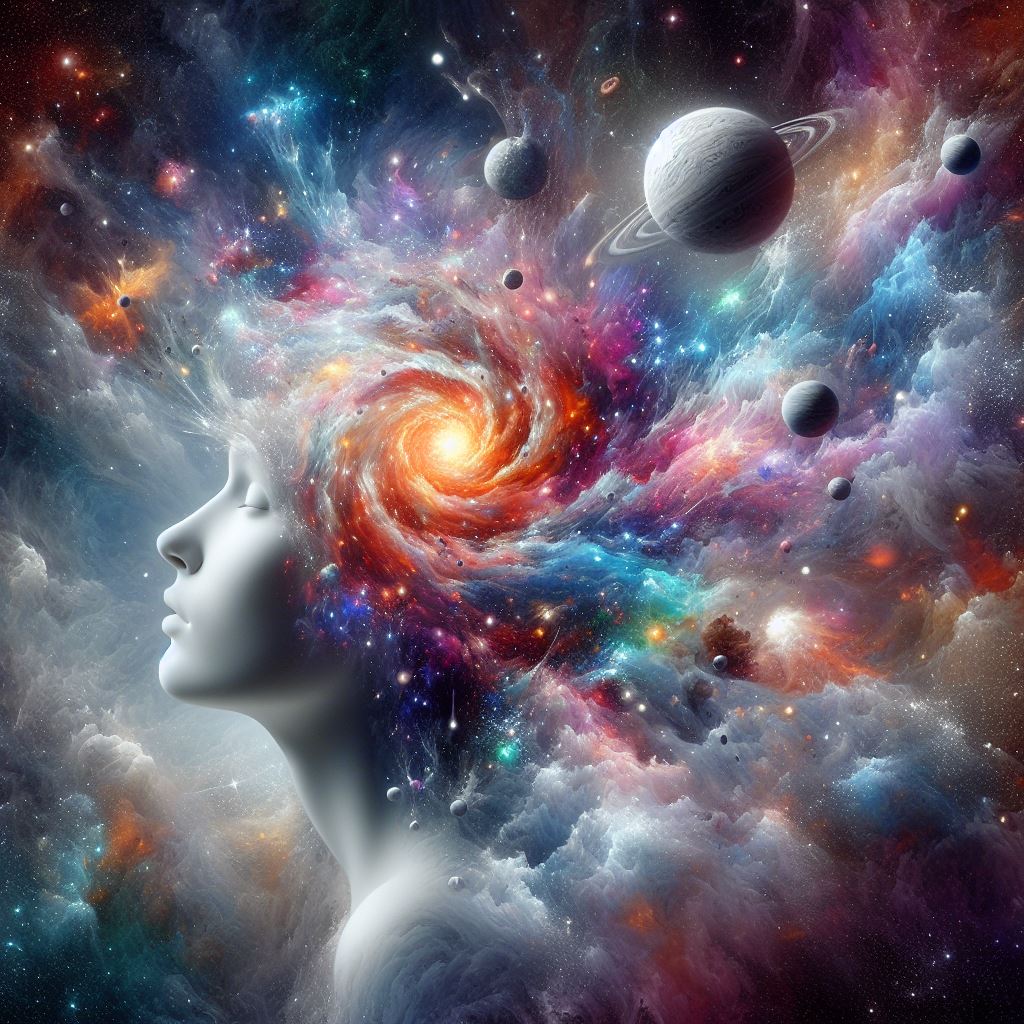
Amidst the diverse philosophical theories addressing the mind-body problem, panpsychism offers a particularly intriguing perspective. This philosophy posits that consciousness is a fundamental and ubiquitous aspect of the universe, suggesting that all matter exhibits some form of consciousness, no matter how basic. This idea stretches our conventional understanding of consciousness beyond the confines of human and animal minds to encompass the entire cosmos.
| Follow my ongoing journey through the philosophy of mind and body—including the mysteries of consciousness—by exploring the related articles linked below. You’ll also find a complete reference list for further reading. |
| Articles | References |
Panpsychism: A Universal Consciousness
Panpsychism derives from the Greek roots “pan” (all) and “psyche” (soul, mind), suggesting that “everything has a mind.” This concept is not a modern invention but has historical roots in various philosophical traditions worldwide, including the works of early Greek thinkers like Thales and Plato, and more recently in the philosophies of Spinoza and Leibniz. In contemporary discussions, philosophers like David Chalmers and Galen Strawson have revisited panpsychism as a serious candidate in the discourse on consciousness. Unlike hylozoism, which asserts that all matter is inherently living, or pantheism, which posits that everything is divine, panpsychism proposes that consciousness permeates the fabric of reality.
From the vantage point of panpsychism, the universe itself may be conceived as imbued with a form of consciousness, with all entities, from subatomic particles to galaxies, participating in the continuum of mindful existence. This worldview holds profound implications for various philosophical and religious traditions. For pantheists or pagans, who view the cosmos as sacred and imbued with spiritual significance, panpsychism offers an enticing framework that resonates with their belief in the interconnectedness of all things. The idea that every entity possesses a degree of consciousness or soul-like quality aligns with the holistic perspective that underpins many pagan and pantheistic worldviews.
Indeed, the notion of panpsychism invites us to contemplate the intrinsic intelligence and vitality of the natural world, challenging the anthropocentric perspective that relegates consciousness solely to human or animal minds. By recognizing the presence of consciousness in all aspects of existence, panpsychism fosters a deeper appreciation for the interconnected web of life and invites us to cultivate a more empathetic and reverential relationship with the cosmos. As we navigate the labyrinthine corridors of the mind-body question, panpsychism stands as a compelling invitation to broaden our understanding of consciousness and embrace the wondrous tapestry of existence in all its manifold forms.
In the exploration of panpsychism, a captivating question arises: is the consciousness attributed to all matter akin to mindfulness or self-awareness? Do entities as vast and complex as galaxies, or even the universe as a whole, possess a form of thought? According to panpsychism, the fabric of reality is imbued with consciousness, suggesting that, on some level, these cosmic entities might not just exist, but experience or ‘think.’ This radical idea challenges our conventional views on consciousness, pushing us to ponder the extent and nature of awareness in the universe.
Strengths of Panpsychism
One of the primary strengths of panpsychism is its elegant solution to the mind-body problem. It avoids the dualistic trap of categorizing mind and matter as fundamentally distinct. By infusing consciousness into the fabric of all matter, panpsychism provides a monistic framework that unifies the mental with the physical. This approach offers a cohesive explanation for the emergence of complex conscious experiences in humans, proposing that these are not random occurrences but extensions of the universe’s inherent properties.
Moreover, panpsychism could potentially bridge the explanatory gap in neuroscience and psychology concerning how subjective experiences arise from physical brain processes. If consciousness is a basic feature of all matter, then its manifestation in higher organisms requires less of an ontological leap.
Weaknesses and Criticisms
However, panpsychism is not without its criticisms. One major challenge is the “combination problem,” articulated by William James and more recently discussed by Chalmers. This problem questions how simple, individual units of consciousness combine to form the rich, integrated conscious experiences characteristic of human beings. Furthermore, panpsychism struggles to provide a clear mechanism by which these combinations occur, leaving a significant explanatory gap.
Another critique is that panpsychism might dilute the meaning of consciousness by applying it too broadly. Skeptics argue that attributing consciousness to simpler systems like electrons or atoms could render the term meaningless or overly expansive, thus undermining the practical utility of the concept in understanding human and animal consciousness.
Panpsychism and Modern Science
Linking panpsychism to modern science, particularly quantum mechanics, provides a fertile ground for exploration. Some theorists speculate that the fundamental nature of quantum entities might include consciousness-like properties. This linkage, while speculative, suggests a possible foundation for panpsychism that aligns with current scientific observations and theories.
Conclusion
As we delve deeper into the mysteries of consciousness, panpsychism challenges us to expand our definitions and consider the possibility that consciousness might be as fundamental to the universe as matter and energy. While this idea might seem radical or implausible to some, especially those with a strict materialist viewpoint, it encourages a broader, more inclusive exploration of what it means to be conscious. In the ongoing quest to unravel the mind-body problem, panpsychism serves not only as a philosophical outlier but as a reminder of the vast and often uncharted terrain of human knowledge. Engaging with such perspectives doesn’t necessitate acceptance but rather an open-minded exploration of the possibilities they present, enriching our understanding of the cosmos and our place within it.
Reflection
- How does the concept of panpsychism alter our traditional understanding of consciousness, particularly in terms of its distribution across the universe?
- In what ways could acknowledging a form of consciousness in all matter influence our ethical and environmental considerations?
- Considering the potential implications of panpsychism, what experiments or observations could be designed to test the presence of consciousness in non-sentient matter?

 Treasures of the Elysian Fields
Leave a comment