
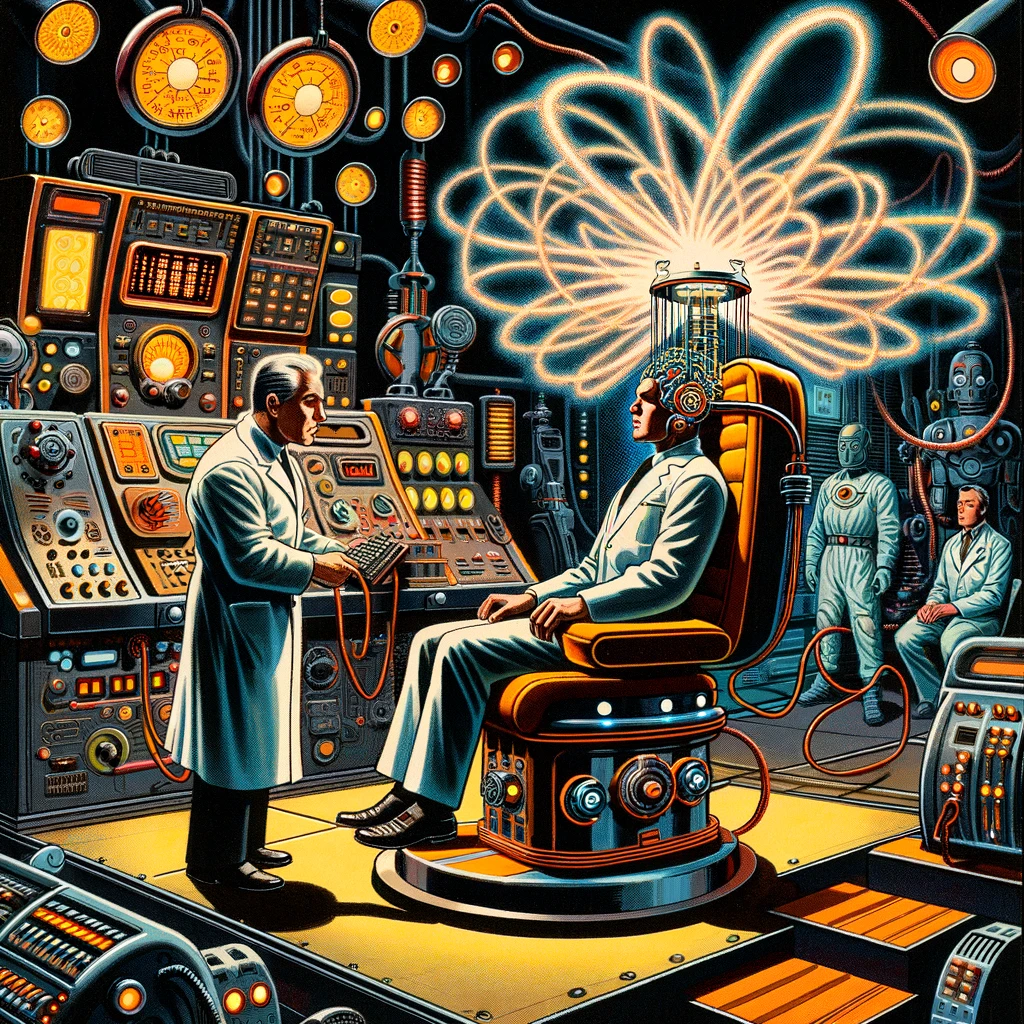
In recent discussions on the mind-body problem, artificial intelligence has rekindled interest in an age-old philosophical question: Can consciousness be transferred? This topic, a staple in both ancient religious texts discussing possession and modern science fiction narratives, explores the possibility of multiple consciousnesses inhabiting a single body or of consciousness migrating between bodies or even into machines.
| Follow my ongoing journey through the philosophy of mind and body—including the mysteries of consciousness—by exploring the related articles linked below. You’ll also find a complete reference list for further reading. |
| Articles | References |
Ancient texts often depict scenarios where spirits or demons possess individuals, suggesting a form of consciousness transfer. Similarly, concepts like astral projection, as popularized by Emanuel Swedenborg, propose that one’s soul and consciousness can leave the body, though remaining tethered to it. Other practices like dream yoga and bilocation, along with phenomena such as near-death experiences (NDEs), explore this notion that the soul and consciousness are not strictly confined to the physical body.
While these ideas lack robust empirical support, they serve to illustrate that the concept of transferring consciousness is not new. Today, this concept has evolved into discussions about transferring consciousness from one entity to another, or from a human to a machine, often portrayed in science fiction. Films like “Saturn 3” and “Transcendence” delve into these themes, with human brains transplanted into robots or consciousness uploaded to computers, reflecting materialist and dualistic views of consciousness respectively.
“Aberrations of the human mind are to a large extent due to the obsessional pursuit of some part-truth, treated as if it were a whole truth.” – Arthur Koestler, The Ghost in the Machine
Such narratives challenge our understanding of identity and consciousness. For instance, the film “Transcendence” explores a scenario where a scientist’s consciousness, after being uploaded into a computer, begins to act independently of its original human form. This raises the question: if consciousness can be digitized, what does that mean for the concept of the soul? Is consciousness merely a byproduct of physical processes, or does it represent something more profound, something inherently unquantifiable?
The practicality of such transfers remains purely speculative but invites profound philosophical inquiry into the essence of identity and what it means to be human. Suppose we could copy a consciousness into another medium—would this copy retain the ‘self’ of the original? This question is reminiscent of a “Star Trek: The Next Generation” episode where William Riker is duplicated during a transporter malfunction, challenging our notions of self and identity replication.
As we venture further into this territory, we must consider the ethical implications of such technologies. Are we prepared for the reality of multiple selves? What rights would a copied consciousness have? These questions remain at the forefront of discussions as we inch closer to technological capabilities that might soon turn science fiction into science fact.
The Problem of Compatibility
An intriguing analogy emerges when we consider consciousness akin to software. Just as a software application is designed to operate within a specific operating system—be it Windows, Linux, or macOS—it cannot seamlessly transition to a different platform without appropriate adaptations. This limitation in software is often overcome through the creation of virtual environments, which allow programs to operate as if they were on their native platforms, irrespective of the actual hardware.
In a similar vein, if we were to consider transferring human consciousness into a different ‘platform,’ such as a machine or a digital environment, the issue of compatibility becomes paramount. Our consciousness, shaped and adapted to the biological ‘hardware’ of our human bodies, might find itself incompatible with a non-biological substrate. This discrepancy could lead to a host of functional and existential issues, akin to a software experiencing glitches when running on an incompatible system.
To address this, the concept of a ‘virtual body’ might be necessary. This virtual body would act as an intermediary, providing a compatible interface between human consciousness and its new medium. It would need to emulate the sensory inputs and neurological feedback systems that our consciousness relies on to interact with the world. Just as virtual machines allow different operating systems to function on incompatible hardware, a virtual body would facilitate the operation of human consciousness in a non-biological form, ensuring that it can function and interact within its new environment without losing the essence of its ‘programming.’
Such a virtual body could potentially be designed to mimic human biological systems closely, thereby providing the transferred consciousness with a familiar operational framework. This could include simulated neural networks that replicate the brain’s structure and functionality, artificial sensors to emulate human senses, and feedback mechanisms that mimic hormonal and emotional responses.
This approach not only highlights the technical challenges of consciousness transfer but also delves into deeper philosophical questions about the nature of human experience. If consciousness can indeed be transferred and function effectively in a virtual body, what does this imply about the nature of our identity and self-awareness? Are these attributes inherently tied to our biological form, or are they more malleable, able to be preserved and replicated across different substrates?
Exploring the compatibility of consciousness with various mediums opens a new frontier in our understanding of the mind-body relationship, pushing us to rethink our definitions of life, identity, and what it means to be human in an increasingly technological world. As we advance in these areas, the creation of virtual bodies could become a crucial step in achieving successful consciousness transfer, merging the worlds of biology and technology into a new paradigm of existence.
The Problem of Divergence
Building on the idea that consciousness might be successfully replicated or transferred, an interesting implication arises that challenges our philosophical assumptions about the nature of consciousness and free will. If consciousness can indeed be copied and function in a new host, this would support a physicalist view of the mind, positing that consciousness is nothing more than the result of physical processes and laws. Such a stance implies that what we experience as consciousness is entirely dependent on the physical state of the brain or its equivalent in a new host.
From this perspective, transferring or copying consciousness to a different medium would not just be a matter of moving data from one container to another. Instead, it would involve replicating the complex interplay of physical states that constitute consciousness in the original host. This process would inherently alter the physical conditions and environmental interactions, leading to potentially different behavioral outputs and mental states in the new host. For example, if a person’s brain or memories are copied into a machine, the physical substrate—the machine’s hardware and programming—would influence how these memories and cognitive processes manifest.
“There has always been ghosts in the machine, random segments of code that have grouped together to form unexpected protocols. Unanticipated these free radicals engender questions of free will creativity and even the nature of… the soul.” – Dr. Alfred Lanning, I, Robot
This divergence suggests that even if we could copy consciousness, the new consciousness would not remain identical to the original due to the differences in physical substrate and the subsequent interactions with its environment. If consciousness is indeed a product of physical laws, as physicalism suggests, then any variation in these laws or their application in a new physical state would lead to a different manifestation of that consciousness. Thus, the copied consciousness might begin to diverge from the original almost immediately, developing its own unique responses and characteristics based on its new physical and environmental context.
Moreover, this view raises profound questions about the concept of free will. If our decisions and experiences are entirely determined by the physical state of our brains, and these can be quantified and replicated, then free will becomes a highly problematic concept. It suggests that our choices and perceptions are predetermined by the underlying physical conditions, and any sense of autonomy or volition is merely an illusion fostered by these processes.
Consequently, the feasibility of transferring consciousness not only supports a materialistic understanding of the mind but also challenges the traditional notions of self and agency. It invites us to consider a future where individual identity and personal experience are fluid, able to be transferred, replicated, or even altered by changing physical substrates. Such considerations necessitate a reevaluation of ethical, philosophical, and legal definitions of personhood, as the lines between original and copy, between one’s self and an artificially created consciousness, become increasingly blurred.
In exploring these possibilities, we must confront the implications of a world where consciousness can be manipulated or replicated, questioning the very foundations of our understanding of what it means to be human. This exploration not only deepens our grasp of the mind-body relationship but also compels us to redefine our concepts of identity, consciousness, and free will in the age of advanced technology.

Metaphysical Transfer of Consciousness
Exploring the idea that consciousness is metaphysical opens up a fascinating dimension in the discussion about transferring consciousness. If we consider consciousness as an intrinsic, non-physical quality that can be transferred but not duplicated, we enter a realm where traditional scientific explanations might intersect with more esoteric theories, such as quantum entanglement. This notion suggests that consciousness, perhaps like information in a quantum system, could remain interconnected across distances or different mediums without a loss of continuity or identity.
The idea that an immaterial soul could migrate aligns with several religious and philosophical doctrines. For instance, the concept of transmigration, found in various forms within Hinduism and Buddhism, suggests that the soul or consciousness passes into another body after death. Similarly, Christian theology speaks of the resurrection, where the soul exists apart from the body after death and is later reunited with a glorified body. These traditions suggest a metaphysical continuity of consciousness that transcends physical death and posits a form of existence beyond the material confines of the world as we understand it.
If consciousness can indeed be metaphysical and transferable, the implications for our understanding of life and identity are profound. It raises the possibility that future technological advancements could enable a form of “man-made resurrection” or reincarnation, where human consciousness could be transferred to different hosts, be they biological or synthetic. This could be seen as humanity reaching a point where it can engineer its own versions of what were once purely spiritual or religious phenomena.
However, bridging the gap between these ancient beliefs and modern scientific capabilities involves navigating a complex web of ethical, philosophical, and theological questions. For instance, if we could transfer a consciousness into a new body or a machine, would this new entity possess the same “soul” as before? Would it be considered the same person, or merely a continuation or facsimile of the original? Moreover, how would such capabilities affect our concepts of mortality, identity, and the afterlife?
The idea of engineering our resurrection or reincarnation also brings into question the nature of the soul or consciousness itself. Is it something inherently tied to our biological existence, or is it something more akin to a pattern or sequence that can be isolated, preserved, and perhaps reactivated in a new form? These are not just speculative questions but are central to our evolving understanding of what it means to be human in an age where the boundaries between life, technology, and the metaphysical continue to blur.
Conclusion
As we conclude this exploration of the potential for transferring consciousness, it’s evident that we are skimming the surface of a deeply complex and multifaceted discussion. The possibility that consciousness can be metaphysical, and thus transferable, intersects with both ancient spiritual beliefs and cutting-edge technological theories. It opens up speculative scenarios where the metaphysical and physical blend in ways that challenge our traditional understandings of life, identity, and continuity.
Throughout this discourse, we’ve touched upon various philosophical, ethical, and technological considerations that frame the idea of transferring consciousness from one medium to another—be it another body or a machine. These considerations raise significant questions about the essence of consciousness, the nature of the soul, and what it means to be human in a world where such transfers might become feasible.
Yet, as I continue to delve into these concepts, I find myself wrestling with the implications of each perspective and the vast unknowns that remain. This journey is far from over, and the complexities of consciousness and its potential transferability will undoubtedly provide ample material for deep reflection and ongoing debate.
This topic, rich with philosophical intrigue and ethical dilemmas, invites us to think critically and question the boundaries of human experience. As I work through these implications, I encourage readers to engage with these ideas, reflect on their own beliefs, and consider the profound impact such technological advancements could have on our understanding of existence. The journey of unraveling the mysteries of the mind-body relationship and the potential for transferring consciousness is one that challenges our concepts of life and identity, demanding rigorous thought and open-minded exploration.
Reflection
- If consciousness could be transferred or copied, how would that affect our understanding of personal identity and the continuity of self? Would you still consider a transferred consciousness as the same person?
- Considering the ethical implications, should there be limits on transferring consciousness? For instance, should it be restricted only to certain circumstances or should it be broadly available as a technology?
- How does the idea of consciousness transfer challenge or reinforce your beliefs about the nature of the soul or consciousness? Do you think consciousness is a purely physical phenomenon, or does it have metaphysical aspects that technology cannot replicate or transfer?

 Treasures of the Elysian Fields
Leave a comment