

Overview
This term paper, crafted over a decade ago, delves into the complex topic of the applicability of Old Testament laws to contemporary Christianity. At the time of its writing, this discourse aimed to address persistent inquiries regarding the relevance of ancient Mosaic regulations to modern Christian practice. The inherent tension between continuity and discontinuity in interpreting these laws often perplexed scholars and laypersons alike, prompting rigorous theological exploration.
The inquiry into the Old Testament laws has historically been a point of contention and confusion within religious discourse. Atheists and skeptics, in particular, have found certain aspects of these laws abhorrent and have often leveraged them as points of criticism against Christianity. However, this term paper seeks to provide a nuanced perspective that could potentially mitigate these tensions by offering a comprehensive examination of the theological, historical, and interpretative dimensions surrounding the Mosaic Law.
In the comments from reviewers provided below, you’ll find insights and reflections from contemporaneous readers, shedding light on various aspects of the paper and its contribution to the ongoing theological dialogue. Through this exploration, it is hoped that readers will gain a deeper understanding of the nuanced perspectives surrounding the Old Testament laws and their significance within Christian theology and practice.
Law and Gospel
Is the Old Testament law applicable to Christians today?
Introduction
Often, the topic of the Old Testament law comes up when discussing Christianity to non-believers. Skeptics and non-believers often assume that when the Christian says the Bible is inerrant that somehow that means the Christian should follow all aspects of Mosaic Law. Often, Christians are ill-equipped to answer questions as to how the Mosaic Law applies to Christians today. The purpose in writing this is to answer the question, is the Old Testament law applicable to Christians today?
Continuity verses Discontinuity
Some Christians approach the issue of the Mosaic Law’s applicability to Christians in terms of continuity verses discontinuity. Those that hold to Continuity of the Mosaic Law find that it is applicable to the Christian life. While those that hold to discontinuity hold that the Mosaic Law is not applicable to Christians. However, from scripture it seems as if neither extreme is tenable. Theologian, Douglas Moo says that continuity versus discontinuity is too simplistic of a solution for a very complex question. Rather, there seems to be some sort of spectrum between discontinuity and continuity to which Christians find themselves all over the spectrum (Feinberg 1998, 204). As Strickland puts it, “Perhaps the truth lies somewhere between these extremes” (Bahnsen, et al. 1996, 229).
Paul’s Statements of the Law
It is important to note that Paul makes a number of positive comments about the Mosaic law. Paul, in his letter to the Romans, affirms that the law is, “holy, and the commandment is holy and righteous and good” (Romans 7:12). The new life of the spirit enables the regenerate to fulfill the Law (Rom 8:3-4; 13:10; Gal 5:14). Comments like these and others definitely give the impression that Paul might support continuity of the law in the Christians’ life. However, just because the law is holy, doesn’t necessarily mean it is applicable to the Christian today.
Likewise, Paul has a number of statements that are negative comments against the law and seem to favor discontinuity. When Paul speaks about the law he uses terms like, dying to the law (Gal. 2:19), not under the law (1 Cor. 9:20 & Romans 6:14), we have been released from the law (Romans 7:6), law was never intended to be a way of works based righteousness (Gal 3:21), and, the law has been set aside (Ephesians 2:15). These comments, among others, seem to send a clear message for discontinuity of the Mosaic Law.
Part of the issue in understanding Paul’s statements regarding the law is his use of the Greek word nomos (law). The problem is that Paul uses nomos in three to four ways in his writings and it is often difficult in determining which way he is using it. First, he uses it to refer to the Old Testament, in whole or in part. Sometimes, to mean the five books of Moses, at other times he uses it to mean the Mosaic covenant with Israel, or he uses it to mean the whole of the Old Testament including the prophetic books. Second, he uses it as a general principle of law. Third, he uses it in conjunction with the New Testament dispensation/covenant (Romans 3:27). Finally, he may also be using it to mean legalism like in Romans 10:5 and Galatians 3:18 (Bahnsen, et al. 1996, 246-248). In looking at each of his statements like those in Romans 7, the question is, is Paul talking about being free from the law or free from legalism?
Strickland explains that Paul’s comments can be understood in a harmonious manner in that, “the law properly understood was to reveal the problem of sin and the necessity of grace in redemption, but the law is not seen as binding for the church saint” (Bahnsen, et al. 1996, 279).
Jesus and the Law
Jesus’ statements about the law seem to take the law to a whole new level, which seems to find Jesus advocating for the continuity of the law. For example, Jesus says the law abides forever (Matthew 5:17-19). Jesus also distinguished between weightier and lighter matters of the law (Bahnsen, et al. 1996, 195). For example, Jesus talks about anger and lust as equivalent to murder and adultery although nothing in the Old Testament suggests anger and lust were part of the original law (Bahnsen, et al. 1996, 348). It is as if Jesus was putting his authoritative commands alongside those of the Mosaic Law (Bahnsen, et al. 1996, 349).
Jesus comments to the Pharisees also seem to point in the direction of continuity but not in the way the Pharisees understood the Mosaic Law. Some see Jesus as elucidating the spirit of the law verses the letter of the law. In a number of examples Jesus held people more accountable to the sanctity of the law (Bahnsen, et al. 1996, 38). It’s as if Jesus always saw the law as being more than is expressed in the words of the law (Bahnsen, et al. 1996, 55). Jesus could have been advocating for continuity by focusing on the intent of the law, the spirit of the law, the motivation in obedience to the law, or possibly to a higher law.

Love as Motive and Basis
Some also see that Jesus simplified the complexity of the Mosaic law by focusing on love (Bahnsen, et al. 1996, 39). Jesus reaffirmed love for God and your neighbor, as the greatest commandment (Lev. 19:18; Deut 6:5: Matt. 22:37-40). VanGemeren makes the point that Jesus’ focus on love and the Mosaic law are not opposed but complementary to one another (Bahnsen, et al. 1996, 33). He also points out that love is what motivates Christians to keep the law (Phil 2:12) (Bahnsen, et al. 1996, 43). The question concerning Jesus’ comments about love is, is love the basis for Mosaic Law or should love be the motivation for the Christian?
Moral, Civic and Ceremonial Laws
VanGermeren and other Christian Theologians often divide the 613 Mosaic laws into three categories of laws (Bahnsen, et al. 1996, 30-31). “In the Old Testament we see three varieties of law. First, there is the category of moral laws. These were the ethical standards and principles by which the Israelites were to live. Second are ceremonial laws. These were the laws that regulated Israel’s religious rituals. And the third are civil laws. These laws maintained order in Jewish society” (Story 1999, 17-18).
Their argument is Christ’s death has done away with the need for the ceremonial aspects of the law once Jesus became our High Priest (Heb. 7:27-28) and we no longer need the need the ceremonial laws that focuses on sacrifices of bulls and goats (Heb. 10:4). As for the civic law, that was specifically applicable to Israel. Strickland puts it this way, “the Mosaic law also served to govern Israel as a theocracy with a unique relationship with God” (Bahnsen, et al. 1996, 278). This leaves the moral law typically summed up as the Decalogue (Exodus 20:1-17 & Deuteronomy 5:1-22). According to Bahnsen “the [moral] law is a transcript of God’s character, one’s response to the law is one’s response to God Himself. So of course the law’s moral prescriptions must be seen as good” (Bahnsen, et al. 1996, 94).
By dividing the law into these three categories, it is easy to rationalize discontinuity for civic laws because they were for Israel only and the ceremonial laws because Jesus was the fulfillment of those laws. Continuity is then applied to the moral laws. For Christians, the moral aspect of Mosaic Law is applicable and binding on the Christian (Bahnsen, et al. 1996, 53). This nicely resolves the tension between Paul’s negative and positive comments on the law and Jesus comments against the Pharisees and His application of the spirit of the law.
However, the chief difficulty with this position is that the Bible does not treat the Mosaic Law as having three different categories of law. In the Old Testament, you will note that the laws of these supposed categories are intermixed indicating no differentiating by category. Certainly, the three categories of laws are rationally justified; however, this distinction is never made in the New or Old Testament. The law is always taken as a whole (James 2:10, Galatians 5:3 and Matthew 5:19). Kaiser agrees that the Bible does not explicitly classify the laws according to the categories listed (Bahnsen, et al. 1996, 189). However, he feels the application of categories is justified, in part, because other classifications such as systematic theology and the word Trinity are not in the Bible as well. I disagree. The Bible definitely has the concept of the Trinity even if it doesn’t have the word “Trinity”. The problem with the concept of categories for the laws is that they are not hinted at in the Bible. Strickland concludes “that any clear biblical testimony to a threefold division is lacking” (Bahnsen, et al. 1996, 261). Citing Richard Longenecker, Moo explains, “the continuity of the law in the new covenant cannot be found on such distinctions among different ‘kinds’ of laws” (Bahnsen, et al. 1996, 337).
Another problem with this trichotomy of law is the issue of the fourth commandment, to remember the Sabbath, which most feel has to do with ceremonial law and the idea that the Decalogue is a summary of moral law (Bahnsen, et al. 1996, 336-337). This would mean the Decalogue is not purely a summary of the moral law but that it has ceremonial as well or that the Sabbath is somehow a moral law. If the fourth commandment is categorized as moral law then it is applicable to the Christian under this understanding. The only solution for proponents of the Decalogue being a summary of God’s moral law is that of the seventh-day Sabbatarian (D. A. Carson 1999, 392). This would mean most Christians are in violation of the fourth commandment.
The Law and Salvation
Often misunderstood by the Pharisees of Jesus’ day, and Christians and skeptics today, is the view that the law and works are a means of salvation. According to Bahnsen, the scripture does not present the Mosaic Law as opposed to the grace of the new covenant. He thinks the misunderstanding comes from dispensational theology (Bahnsen, et al. 1996, 97). His point is that the Mosaic Law was not what saved people prior to Jesus Christ, it was faith then and it is faith now. Clearly faith is what saved Abraham (Romans 4:3) and what saves us today (Romans 4:5).
A Higher Law
At first glance one may conclude that Jesus’ position was one of continuity. It is important to realize, that during His ministry, Jesus did not abrogate the law. If anything, He held people more accountable to the sanctity of the law (Bahnsen, et al. 1996, 38). He made the point that obeying the law without love for God and for neighbor is useless. This seems to take continuity in a new direction. Taken with the statements of Paul, which seem to point in the clear direction of discontinuity, it seems we are holding continuity and discontinuity in tension. Moo asks, “Can we find a framework that is capable of organizing into a coherent picture the various texts about the Mosaic Law without imposing forced unnatural meanings on those texts?” (Bahnsen, et al. 1996, 320)
Moo offers the best explanation that makes sense of the divergent statements that point toward continuity with those that point discontinuity. The “law” under which Christians live is continuous with the Mosaic Law in that it is based on God’s eternal moral norms, which never change, are clearly expressed in both. In addition, there is discontinuity in that fact that Christians live under the “Law of Christ” (Galatians 6:2) and not under the Mosaic Law” (Bahnsen, et al. 1996, 89). This means the basis for the Mosaic Law and the Law of Christ is the same eternal moral law of God.
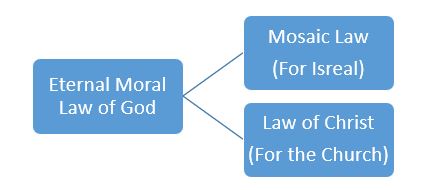
Moo’s diagram
It also means the Old Testament is continuous in that it is a guide for Christians to see how God’s eternal moral law was applied for Israel. Moo puts it this way, “Consequently, while the law of Moses may no longer be a direct and immediate authority for the Christian, its teaching remains indirectly applicable to us through the fulfillment of that law in Christ and his law” (Bahnsen, et al. 1996, 315). This idea is in line with the Baptist Catechism (The Baptist Catechism as presented by the Charleston Association 1813) and the Lutheran Catechism (Kuske 1982) that both state that the law is a guide for Christians.
Banhsen looks at this from another angle and sees a culture gap as a reason for discontinuity (Bahnsen, et al. 1996, 100). He goes on to say that God communicated to his people in terms of their own day (Bahnsen, et al. 1996, 101). And finally, God’s moral absolutes still need to be properly interpreted and applied to the modern world (Bahnsen, et al. 1996, 115). This does not seem to be in conflict with Moo’s concept of eternal moral law of God. The culture Gap that Banhsen sees can be seen simply as a culturally specific application of God’s eternal moral law.
Bahnsen holds that Old Testament laws continue to be binding in the New Testament unless they are rescinded or modified by further revelation. He also sees that the revealed laws are a reflection of God’s eternal moral character and as such are universal and applicable to general moral situations (Bahnsen, et al. 1996, 142). Likewise, Kaiser states that “the foundation of the law in the Old Testament is that it proceeds from God” (Bahnsen, et al. 1996, 197). Strickland points out that the Law of Christ encompasses the same moral standard as the Law of Moses and is written on the heart regenerated by the Holy Spirit (Bahnsen, et al. 1996, 272). Moo agrees that the implied basis for the entire law is God’s character (Bahnsen, et al. 1996, 335). God’s character can be rightly equated with God’s eternal moral character in this regard and perhaps the differences are between some theologian may not be as vast as may first appear.
What we have then, is God’s eternal moral law is based on God’s own character. The Mosaic Law, which was given specifically to Israel[1] was based on God’s eternal moral law. Christ’s law for the Church is also based on His eternal moral law. If they are both based on the same eternal moral law then there should rightly be overlap, similarities and some level of continuity. However, the Mosaic Law is not directly applicable to the Christian. Not only will there be culture differences between the Mosaic Law and modern times but there will also differences in purpose.
Purpose of the Law
The Mosaic law was applicable to Israel as a covenant between God and Israel and His promise to multiply them, prosper them and give them His land (Joshua 1:8; Deut 30:3-5). This promise was given for Israel, for a Theocracy, and includes civic laws and health and safety laws. As Strickland puts it the Mosaic Law demonstrated God’s graciousness. It made provision for Israel to approach God for worship, and to govern Israel’s Theocratic government (Bahnsen, et al. 1996, 236-239). No doubt, the law was also a prophetic tool pointing to the coming Messiah.
The Mosaic Law also served other purposes beyond the scope of Israel. Paul says the law is used as a tutor (paidagogos), or better yet, a babysitter for us until the Messiah came (Bahnsen, et al. 1996, 244-245). The law exposed sin (Gal 3:19; Romans 3:20) (Bahnsen, et al. 1996, 240-241) and was used to warn, convict and condemn (Bahnsen, et al. 1996, 53) us of our sin. According to Luther’s Catechism, the purpose of the law is to curb sin. It shows people their sins and, for Christians, it acts as a guide (Kuske 1982, 45-52). As VanGemeren puts it, the law was also used to teach people they were guilty and under condemnation (Bahnsen, et al. 1996, 32). In this way, the law exposed the depth of our depravity and our need for salvation.
While the Mosaic Law exposed our need for salvation, it was never given to Israel as a means of salvation (Bahnsen, et al. 1996, 233). Strickland saw the law in the Mosaic Law as being for the sanctification of Israel and not the justification of Israel (Bahnsen, et al. 1996, 249). Likewise, the Law of Christ can be seen not as a means of salvation for the Church but a means of sanctification. According to VanGemeren, the purpose of the law is growth in grace and not for justification or merit (Gal 3:21) (Bahnsen, et al. 1996, 42) .
If Christians have the Law of Christ, what use is the Mosaic Law for the Christian? Remember both the law of Christ and the Mosaic Law flow from God’s eternal moral law which is, in turn, based on God’s moral character. From that vantage point, Christians should see the Mosaic Law as a useful guide for their own lives. VanGemeren puts it this way, “the law is God’s instrument of conforming us to the image of Jesus Christ” (Bahnsen, et al. 1996, 51).
Law Internalized
God did not just give us the Mosaic Law, He also gave everyone a conscience (Romans 1:18-20). We are all made in the imago dei, (Image of God) and as such we know morally right from wrong. God revealed Himself to all of us including His righteous decrees. This law was written within humans to confirm the guilt of the Gentiles (Bahnsen, et al. 1996, 276) and so that people are without excuse. To say that we are made in the image of God is not to say that we can save ourselves, clearly we are depraved in the sense that we cannot save ourselves but not to the point that we cannot tell right from wrong.
In the Old Testament, God promised to put His law in people minds and hearts (Jer. 31:33). What God was promising ancient Israel was that the law would not have to be written but that one day the law would be internalized by His children (Bahnsen, et al. 1996, 45). Paul makes the Point that the law is by nature, spiritual (Romans 7:14) and that we now live according to the spirit (Romans 8:4). According to Strickland, since the Holy Spirit is indwelling the believer, there is no longer a need for a long codified law (Bahnsen, et al. 1996, 277). VanGere puts it this way, “When we are filled with the Spirit, the law will not only convict us, but will also lead us to look at Jesus Christ” (Bahnsen, et al. 1996, 57). The indwelling of the Holy Spirit becomes our guide aiding us in the sanctification process.
Maturity
Paul makes the point that the law is a tutor (babysitter) until Christ comes. This suggests that there is, in some respect, a process of progression. Some Christians look at the Old Covenant and the New Covenant as a natural progression in God’s interaction with man (Bahnsen, et al. 1996, 15). Or, what can be called maturity in the relationship. This concept of maturity is not limited to covenant theologians, some dispensationalist, such as Pierre Poiret, also view the progression of dispensations as different levels of maturity of man and in God’s dealing with man (Ryrie 1995, 71).
When Christ came and sent the Holy Spirit, we no longer needed the babysitter. When we love Christ and willfully serve Him, we are being compelled by a desire to do what is right. Thus, when we are free from the law, our motivation is not out of fear of punishment. We are now motivated by love. Calvin puts it this way, “God chooses rather to invite his people by kindness than to compel them to obedience from terror.” (Bahnsen, et al. 1996, 50).
Dr. Cloud and Dr. Townsend talk about the importance of setting rules for young children and then, as they get older, they see the wisdom of those rules and often, at the very least, follow the spirit of those rules. “More often than not, they use boundaries to perform a function. They set limits to freedom and then enforce them for the child’s protection. Through this process, the child internalizes the limits as wisdom and slowly begins to take care of herself” (Cloud and Townsend 1998, 20). By setting a bedtime as a young child, eventually when the child grows up and is on his/her own he/she may not go to bed at nine but will definitely see the importance of getting enough sleep. This is much like the analogy of training wheels on a bike or, to put it terms that we have used, following the spirit or intent of the law and not the letter of the law.
But if the law is written on our hearts, can’t that become subjective? Of course, this is why we have the written law as guidance. We may wonder in our thoughts if something is the right thing to do or not. Often the answer is found in the Old Testament. The written law, because it comes from God’s holy and moral character, is an excellent way to test all questions of morality. Some of them are so important that we take them for granted, like the Ten Commandments.
Conclusion
For the Christian, the Mosaic Law, in a technical sense, does not continue on into the new covenant or this dispensation. However, because the Mosaic Law is derived from God’s eternal moral law and His character, in some ways it will be applicable. Based on Jesus’ comments about the law, we know God’s moral character is based on love. I think that once Christians understand that they are not bound to the law as a means of salvation, they are then free to be motivated by love rather than wrath.
Bibliography
- Bahnsen, Greg L., Walter C. Kaiser Jr., Douglas J. Moo, Wayne G. Strickland, and Willem A. VanGemeren. Five Views on Law and Gospel. Grand Rapids, MI: Zondervan Publishing House, 1996.
- Baylis, Albert H. From Creation to the Cross. Kindle Edition. Zondervan, 2010.
- Boice, James Montgomery. Foundations of the Christian Faith. Downers Grove, Illinois: InterVarsity Press, 1986.
- Cloud, Henry, and John Townsend. Boundaries with Kids. Grand Rapids, MI: Zondervan, 1998.
- D. A. Carson. From Sabbath to Lord’s Day. Edited by D. A. Carson. Eugene, OR, 1999.
- Feinberg, John S., ed. Continuity and Discontinuity (Essays in Honor of S. Lewis Johnson, Jr.): Perspectives on the Relationship Between the Old and New Testaments. Crossway, 1998.
- Kuske, David P. Luther’s Catechism. Milwaukee, Wisconsin: Wisconsin Evangelical Lutheran Synod, 1982.
- Moo, Douglas J. “Law, Works of the Law and Legalism in Paul.” Westminster Theological Journal, 1983: 73-100.
- Packer, J.I. An Introduction to Covenant Theology. Kindle Edition. The Fig Classic Series, 2012.
- Ryrie, Charles C. Dispensationalism (Revised and Expanded). Chicago: Moody Press, 1995.
- Saunders, Peter. “Why Christians may eat shellfish but may not have sex outside marriage .” Christian Medical Comment . April 9, 2013. http://pjsaunders.blogspot.com/2013/04/why-christians-may-eat-shellfish-but.html (accessed April 27, 2013).
- Story, D. Engaging the closed minded: Presenting your faith to the confirmed unbeliever. Grand Rapids, MI: Kregel Publications, 1999.
- “The Baptist Catechism as presented by the Charleston Association.” The Reformed Reader. 1813. http://www.reformedreader.org/ccc/bapcat.htm (accessed April 23, 2013).
- Waltke, Bruce K. Understanding the Old Testament. Grand Rapids: Institute of Theological Studies, 2009.
Comments
Norm:
Wow! What a great paper! You are an excellent writer and thinker. I was truly amazed at the research you put into the paper, and the incredible way you synthesized the ideas and explained them in a logical and systematic way. You truly have a gift. I’m not sure I could have written a paper like this one—so I stand in awe and envy (the good kind of course) of the gift God has given to you. Congratulations!
I have only one suggestion as to content, but several responses:
- I have heard about the three divisions of the Law into moral, civic and ceremonial. I, too, had felt they didn’t always work, but never understood why. You explained why and gave me a better way of thinking about it in your talking about the Mosaic Law (which we are not under) and the Law of Christ (which we are under). You explained that the two are similar and both rooted in God’s “Eternal Moral Law”—this was a new way of looking at this issue, and was very helpful to me. I learned something thru reading your paper.
- SUGGESTION: You never define in your paper the “Law of Christ.” Maybe just a reference to Galatians 6:2, (or including the verse), is sufficient: “Carry each other’s burdens, and in this way you will fulfill the law of Christ.” (page 6, line 8).
- I like the point you bring out that the Mosaic Law has a culture difference and a difference in purpose (page 7). A new idea for me.
- I also liked the point on page 8 that the Mosaic Law (like the Law of Christ) was for “the sanctification of Israel and not the justification of Israel (Bahnsen).” I have taught this point many times in the past, so was glad to see others agreed with me. Salvation came when the Israelites crossed the Red Sea and then proclaimed their allegiance to God at Mt. Sinai. After that God gave them the Law. It’s as if God said, “Now that you are my people, here’s how the relationship works and how you are to be and act as my people.”
- Lastly, the examples from Cloud and Townsend were very helpful illustrations—good job on including them and also on where you placed them in the flow of the paper.
Again, this is an incredible paper. Thanks for sending it to me to review.
Moe
Norm:
Excellent work on your paper, Norm! You got to the point on the Sabbath which I think is very instructive. Someone has summed it up that for the Christian the Law is instructive but not prescriptive. That works for me.
Paper grade: A
Professor
[1] Whether you want to call it a covenant or dispensation in the end what you are saying is there is some sort of discontinuity, otherwise there is no need for subsequent covenants or dispensations.

 Treasures of the Elysian Fields
Leave a comment