
In the intricate tapestry of human history, archaeological finds often serve as windows into the past, offering glimpses of ancient civilizations and their way of life. However, amidst the myriad artifacts unearthed from the depths of time, one aspect of human anatomy has remained shrouded in mystery—the preservation of human brains. For centuries, it was assumed that brain tissue, delicate and prone to decay, would be among the first to vanish, leaving little trace in the archaeological record. Yet, recent research challenges this long-held belief, revealing a treasure trove of preserved human brains dating back as far as 12,000 years.
In a groundbreaking research article by Alexandra L. Morton-Hayward, Ross P. Anderson, Erin E. Saupe, Greger Larson, and Julie G. Cosmidis, published in the Proceedings of the Royal Society B on March 20, 2024, the remarkable catalog of numerous preserved human brains has captured the attention of the archaeological community. Contrary to previous assumptions, these findings suggest that preserved brains may not be as rare as once thought, signaling a paradigm shift in our understanding of soft tissue preservation in the archaeological record.
The researchers’ endeavor to catalog these preserved brains marks a pivotal moment in archaeological scholarship, offering the promise of invaluable insights into ancient human biology and behavior. With the potential for DNA and structural studies to unlock the secrets of our ancestors, these preserved brains hold the key to unraveling millennia-old mysteries. As we embark on this journey into the depths of archaeological discovery, we are poised to uncover a wealth of knowledge that may reshape our understanding of human evolution and the complexities of our shared past.
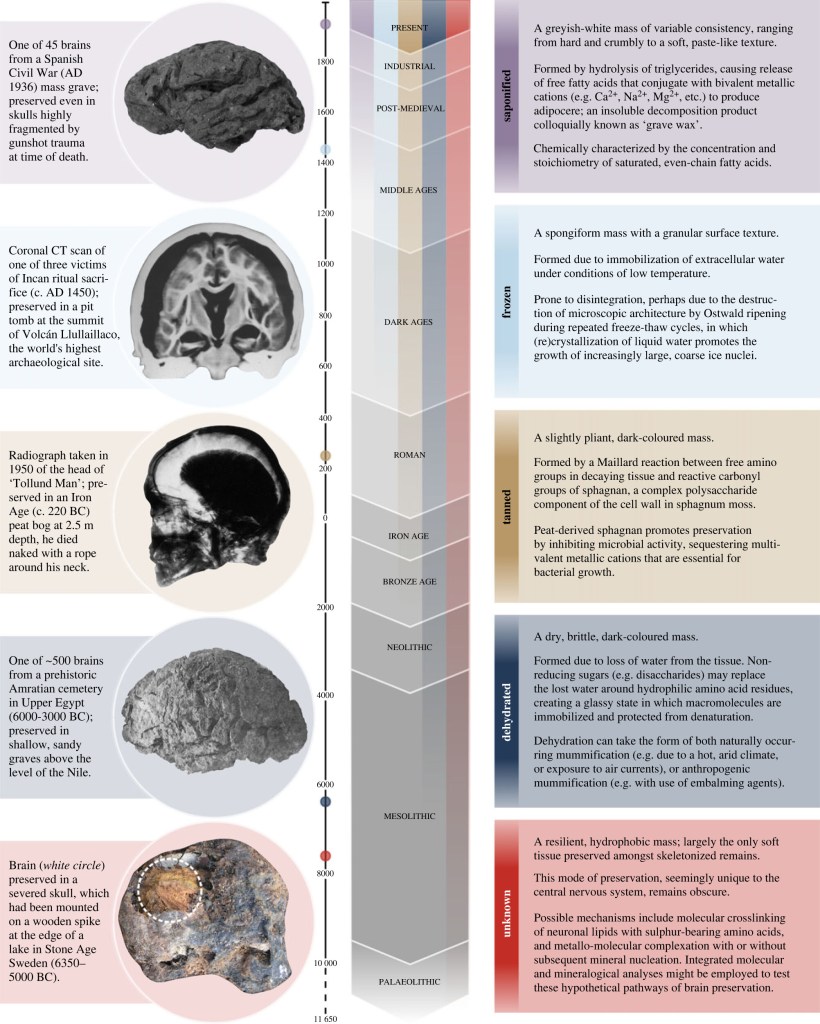
The astonishing catalog of more than 4400 preserved human brains, with over 1300 preserved among skeletonized remains and some dating back 12,000 years, defies conventional assumptions about soft tissue decay. Despite centuries of archaeological study, the prevalence of preserved brains has been vastly underestimated, with perceptions often skewed towards regarding them as unique or exceptionally rare finds. Starr’s examination sheds light on the intricate mechanisms of preservation, ranging from dehydration and freezing to tanning, both anthropogenic and naturally occurring.
What truly intrigues researchers, however, is the preservation of brains in the absence of other soft tissues, presenting an untapped wellspring of bioarchaeological information. This unexpected phenomenon not only challenges existing paradigms but also holds profound implications for our understanding of neurological disease pathogenesis and genetic history. The potential for retrieving ancient DNA from preserved brains opens new avenues for exploring genetic ancestries and evolutionary trajectories inaccessible through modern populations alone.
Moreover, the comprehensive analysis conducted by the research group underscores the need for a systematic investigation into ancient brains. By unraveling the molecular and morphological insights offered by these remarkably preserved organs, we hope future researchers will glean invaluable insights into ancient cognition, behavior, and the evolution of nervous tissues and their functions.
Before I read the paper I did not know that there were preserved brains. I had always heard that mummies had their brains removed and that the brain tissue will start decomposing after death. Even I did not know that we had some let alone over 4000 of them. This is an awesome opportunity to have a glimpse into the past. What will we learn what mysteries will be solved?
Prior to delving into this paper, I held the common belief that preserved brains were a rarity, if not entirely nonexistent. My understanding was shaped by the prevalent notion that brain tissue quickly decomposes after death, a notion reinforced by the practices of mummification where brains were typically removed. The revelation that not only do preserved brains exist but that there are over 4000 of them challenges this long-standing assumption. This newfound awareness presents an extraordinary opportunity to peer into the annals of history and uncover long-buried secrets. What revelations lie dormant within these ancient brains? What mysteries will they help us unravel? As we embark on this journey of exploration, I am filled with anticipation and wonder, eager to witness the discoveries that await us in the depths of time.
Resources
- Human brains preserve in diverse environments for at least 12 000 years, Proceedings of the Royal Society B, Biological Sciences, 20 March 2024,
- 12,000-Year-Old Preserved Human Brains Defy Soft Tissue Decay Assumptions by Michelle Starr

 Treasures of the Elysian Fields
Leave a comment