

On my journey through Lent, I’m eager to share an update on my progress thus far. One aspect I’ve encountered challenges with is meditation. Amidst the hustle and bustle of daily life, quieting my mind has proven to be a daunting task. However, I’ve explored various techniques, including breathing exercises paired with soothing music in the 528 Hz range, aiming to enhance mindfulness. Despite initial struggles, these sessions have offered moments of tranquility akin to a rejuvenating spa retreat.
Previous Post: Personal Journey Through Ash Wednesday and Lent
Abstaining From Alcohol
Reflecting on my Lenten journey thus far, I’m compelled to revisit the initial commitment I made to abstain from alcohol. As stated in my earlier post, this decision was rooted in a desire for spiritual reflection and personal growth. However, what began as an individual endeavor took on new meaning when a friend chose to join me on this path, albeit for different reasons. While my friend pursued abstinence for health and well-being, his companionship has brought unexpected camaraderie to our shared journey, reinforcing my resolve. On St. Patrick’s Day, as my friend engaged in conversations with neighbors about our mutual commitment, I couldn’t help but feel a sense of solidarity and support.
My wife expressed her pride in my ability to attend social events where others were drinking, yet I remained abstinent. This often sparked conversations, typically beginning with inquiries like, “You’re not Catholic, so why observe Lent?” As an atypical Christian, I see value in abstaining, viewing it as beneficial for the mind, body, and soul. For me, this period of abstinence extends beyond religious tradition, encompassing a holistic journey of self-discipline and spiritual reflection. It’s a testament to the belief that there is inherent value in aligning the mind, body, and soul, transcending denominational boundaries and fostering a deeper connection with the divine. Indeed, I believe there’s merit in undertaking a body cleanse for health reasons. It’s akin to a form of spring cleaning for the mind, body, and soul – a concept rooted in ancient Celtic practices associated with the celebration of Ostara or the spring equinox. But more on that later.
You might have noticed that I made an exception to my abstinence from alcohol for St. Patrick’s Day – a day traditionally reserved for indulging in Irish whiskey and Guinness. A humorous remark from an Irish comedian on social media about the necessity of St. Patrick’s Day during Lent for drinking struck a chord with me. Interestingly, while perusing a liquor store for sale items post-Lent, I stumbled upon the nonalcoholic version of Guinness and decided to try it. This unexpected find prompted me to reconsider my decision and allowed me to enjoy a beer with my corned beef on St. Patrick’s Day. Surprisingly, the taste of the nonalcoholic Guinness exceeded my expectations, making me wonder if someone would even notice it was alcohol-free. It felt like a stroke of luck, or perhaps even divine intervention, that I discovered this satisfying alternative. Now, armed with newfound alternatives and a refreshed perspective, I’m successfully maintaining my abstinence throughout the Lenten period.
“The Feast of Saint Patrick, is a religious and cultural holiday held on 17 March, the traditional death date of Saint Patrick, the foremost patron saint of Ireland.”
St Patrick’s Day
During the St. Patrick’s Day weekend, we ventured to a local St. Patrick’s Day festival, a ceilidh where the scene was a vivid display of revelry and green-clad attendees, albeit in comedic costumes that seemed more cheap caricature than homage to Irish culture. The pervasive drinking culture at such events often overshadows the holiday’s religious origins, akin to the festivities of Fat Tuesday preceding Ash Wednesday. How did this religious observance transform into a day synonymous with frat parties and excessive drinking?
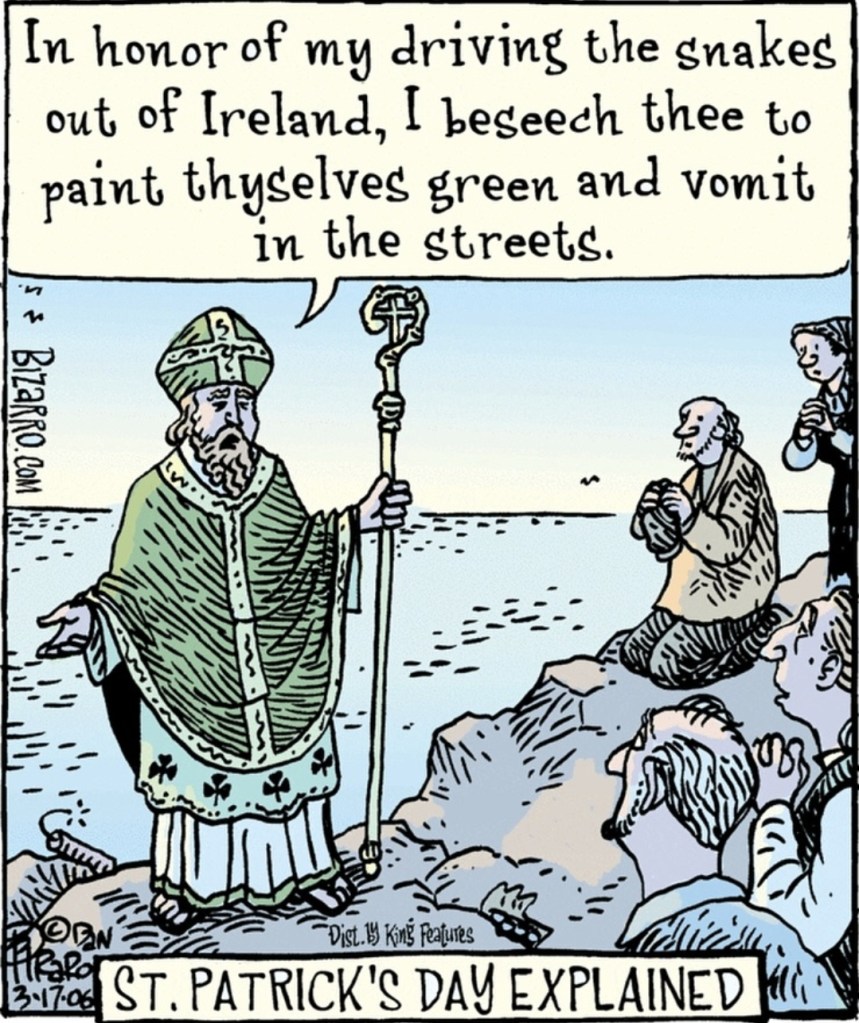
Surprisingly, I stumbled upon a video from Ireland elucidating the historical context of St. Patrick’s Day, revealing that in the past, the holiday was observed as a dry day, with pubs shuttered – a tradition upheld until as recently as 1970. However, conflicting accounts suggest a history of feasting, drinking, and dancing, reminiscent of ancient spring celebrations in Ireland, a topic I’ll delve into further later on.
A Little History
St. Patrick, revered by both Catholics and Protestants in Ireland, serves as a unifying figure whose legacy transcends religious divisions. On St. Patrick’s Day, amidst the Christian season of Lent, Irish families traditionally engage in a dual celebration – starting with morning church services, followed by joyful festivities in the afternoon. During this time, Lenten restrictions on meat consumption are temporarily lifted, allowing people to partake in merriment, dancing, and feasting on the customary meal of Irish bacon and cabbage.
In the United States, the roots of St. Patrick’s Day observances run deep, stretching back to before the nation’s founding, particularly in cities like Boston and New York City. The inaugural parade in Manhattan in 1762 marked the beginning of a tradition that would evolve significantly over the years. While St. Patrick’s Day in Ireland retained a more solemn and religious tone, Irish immigrants brought their vibrant culture to American shores, transforming the holiday into a lively and inclusive celebration. For Irish Americans, it became a cherished opportunity to assert their identity and heritage, solidifying their place in the country’s cultural fabric. Today, St. Patrick’s Day festivities across the U.S. are marked by parades, parties, and spirited gatherings, welcoming people of all backgrounds to join in the revelry and embrace their inner Irishness, blurring the lines of cultural appropriation as everyone seems to claim a bit of the Irish spirit on this festive day.
Connecting with the Distant Past
In contemporary times, the overtly drunken revelry that characterizes St. Patrick’s Day festivities often appears diametrically opposed to its religious roots, seemingly eschewing spiritual observance in favor of hedonistic indulgence. This shift towards a secular celebration devoid of devotion may hold deeper roots in the form of a hidden cultural memory, given the holiday’s timing at the onset of spring, when people embrace the energy of renewal and rebirth. It begs the question of whether elements of revelry, drinking, and dance predate the Christian observance of St. Patrick’s Day, perhaps harkening back to a more pagan or pre-Christian era. Perhaps there is a deeper connection to ancient rituals and traditions, hinting at a complex tapestry of cultural influences that have shaped the modern-day celebration of St. Patrick’s Day.
The proximity of St. Patrick’s Day to the Spring Equinox is significant, with the Northern Hemisphere’s equinox typically occurring between March 19 and 21. This temporal alignment with Ostara, a Celtic Pagan celebration of the equinox, underscores shared themes of new beginnings, fertility, growth, and balance. Ostara’s symbolism resonates deeply with other ancient fertility and spring festivals, such as the Anglo-Saxon Eosturmonath, the Roman Floralia, and the Greek Anthesteria. These traditions collectively reflect a universal reverence for the rejuvenating power of nature and the cyclical rhythms of life.
Ostara, the spring fertility festival venerating the Anglo-Saxon goddess of the dawn, Eostre, is a vibrant celebration intertwined with symbols of renewal and fertility. As the sun rises in the east, signaling the awakening of the earth, it’s a time for sowing the seeds of intentions for the year ahead. Feasting and joyous revelry mark the festivities of Ostara, echoing the burgeoning energy of spring. Ritual cleaning (spring cleaning as mentioned earlier) rituals symbolize the sweeping away of old patterns, making room for rejuvenation and growth. At the heart of the celebration lies the goddess Eostre, the embodiment of the fertile energy bursting forth from buds and blossoms. Key symbols of the holiday, such as rabbits and eggs, speak to the prolific nature of fertility. Rabbits, revered for their legendary reproductive capacity, hold sacred significance for numerous fertility goddesses across cultures, underscoring the timeless association between Ostara and the bountiful blessings of the season.
Transitions
The temporal proximity of St. Patrick’s Day, Easter, and Ostara suggests a natural blending and overlap of behaviors, customs, and traditions. As Ireland underwent Christianization, a transition period likely ensued, during which pagan customs and traditions gradually integrated with Christian practices. People don’t simply abandon traditions and customs when their beliefs change; rather, they often seek to integrate them into their new belief systems, if feasible. The transition process is far from clear-cut; instead, it tends to be messy and complex, lacking clear delineation.
Today, the revelry associated with St. Patrick’s Day, characterized by drinking and festivity, bears a resemblance to ancient pagan celebrations, hinting at the continuity of certain traditions across time. It’s plausible that some individuals sought to preserve cherished aspects of their pagan heritage, perhaps even adapting them to fit within the framework of Christianity. However, not all ancient practices persisted through this transition period, with some fading into obscurity over time. In a modern context, as society shifts from a predominantly Christian to a more secular ethos, a similar process of transition is evident. Customs and traditions once imbued with sacred significance are now being discarded, while others are being reinterpreted through a hedonistic lens to align with the values of a secular society. This ongoing evolution reflects the fluidity and adaptability of cultural practices across different historical epochs and societal paradigms.
Apologies for the digression down a rabbit hole, but it seems we’re delving deeper into a fascinating topic (and yes, I’m aware that rabbits are yet another symbol of spring and fertility). 😉
It’s evident that societies undergo continual change, with shifts in ideas and beliefs invariably leading to transformations in customs and traditions. St. Patrick’s Day serves as a prime example of this evolutionary process. However, it’s important to recognize that while old practices may evolve, they’re not necessarily lost; rather, they undergo a metamorphosis or blend with new influences. This interweaving of Christian, pagan, and secular elements makes it challenging to untangle their origins and trace the genealogy of ideas. Memetic theory offers insight into this complexity, highlighting how ideas replicate and evolve through cultural transmission. Like offspring inheriting traits from their parents, new ideas may bear resemblance to their predecessors but emerge as distinct entities. Determining the genesis of these ideas becomes a quest through time, as they undergo replication and evolution, sometimes returning to primordial concepts or evolving into unrecognizable forms. The genealogy of ideas thus emerges as a testament to the dynamic nature of cultural evolution and the ever-changing landscape of beliefs and traditions.
Conclusion
In conclusion, my exploration of St. Patrick’s Day has revealed a deeper understanding beyond the common misconception of it being solely about partying and revelry. Instead, I’ve come to appreciate the multifaceted nature of this holiday, recognizing that its significance varies among individuals. For me, it’s been a rediscovery of its cultural and spiritual dimensions, prompting a shift in my Lenten practice to include a full 40-day abstinence from alcohol. This journey has been one of learning and reflection, highlighting the evolving nature of cultural traditions and the importance of embracing their diverse meanings. As I continue to navigate Lent, I’m reminded that true understanding often requires us to challenge misconceptions and rediscover the richness of our cultural heritage.

Reflection
- How has your understanding of St. Patrick’s Day evolved through this exploration of its cultural and spiritual dimensions?
- In what ways do your own traditions and beliefs intersect and evolve over time, particularly during periods of cultural celebration like St. Patrick’s Day and Lent?
- Reflecting on the broader context of cultural change, how do you navigate the balance between preserving tradition and embracing evolving meanings and interpretations?
Resources
- The Confession of St. Patrick By St. Patrick
- How the Irish Saved Civilization: The Untold Story of Ireland’s Heroic Role from the Fall of Rome to the Rise of Medieval Europe By Thomas Cahill
- The Immortal Irishman: The Irish Revolutionary Who Became an American Hero By Timothy Egan
- The Irish Identity: Independence, History, and Literature By, Marc C. Conner, The Great Courses
- Ostara Rites and Rituals https://www.learnreligions.com/ostara-rites-and-rituals-2562469
- Easter Is Not a Secretly Pagan Holiday https://www.catholic.com/magazine/online-edition/easter-is-not-a-secretly-pagan-holiday
- Is Easter a pagan holiday? https://www.gotquestions.org/Easter-pagan-holiday.html
- Professor Shares View on Celebration of Easter https://www.biola.edu/blogs/biola-news/2010/professor-shares-view-on-celebration-of-easter
- Culture in the transitions to modernity: seven pillars of a new research agenda by Isaac Ariail Reed & Julia Adams, Theor Soc (2011) 40:247–272, DOI 10.1007/s11186-011-9140-x
- Understanding Social Change https://open.lib.umn.edu/sociology/chapter/20-1-understanding-social-change/

 Treasures of the Elysian Fields
Leave a comment