
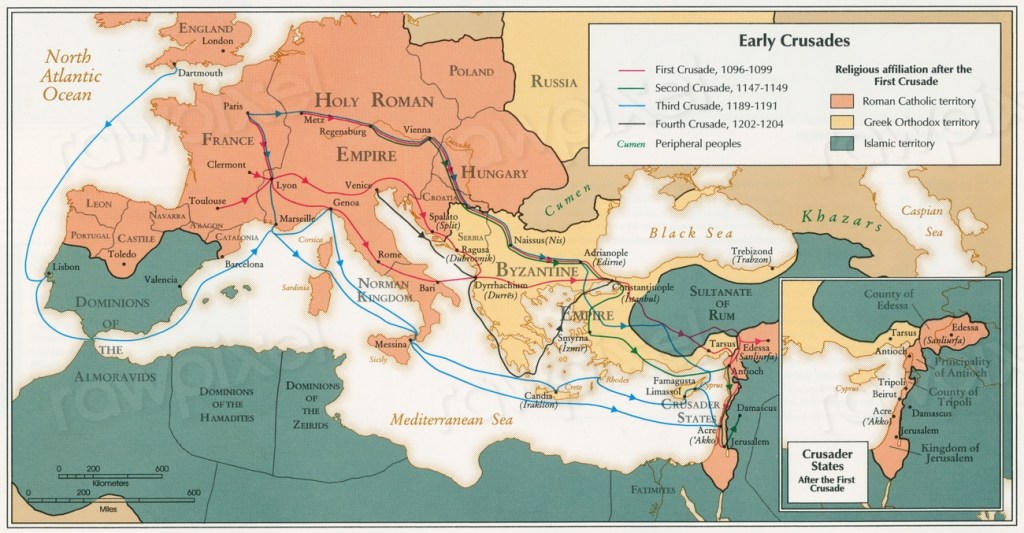
As history often does, the Crusades have left a trail of narratives and interpretations, some accurate, others shrouded in myth and misconception. In the contemporary sphere, discussions around the Crusades have become battlegrounds for ideological warfare, where words like “crusade” carry significant emotional weight and are wielded as rhetorical weapons. The narratives that have emerged paint a picture of religious fanaticism, brutality, and imperialism, often serving as a cudgel against Christianity itself.
Introduction
This blog post constitutes a term paper authored during my historical theology course in 2012. I have long been intrigued by the Knights Templar, as they play a significant role in the narrative of the Crusades. The Knights Templar exude an aura of mystery and romanticism, adding an intriguing dimension to the Crusades. One the other hand, the Crusades are a favored topic of skeptics who often point to them as an indictment against Christianity. The prevalence of extreme caricatures, clickbait sensationalism, and dramatization in television documentaries further compounded the challenge of discerning truth from myth.
Reducing the complexities of the Crusades to a mere tweet would be a disservice to the historical intricacies and varied motives of its participants. Such oversimplification amounts to academic dishonesty, for the Crusades defy easy categorization or succinct summaries. Their multifaceted nature and intricate historical context elude simplistic explanations. Therefore, the challenge lies in unraveling the nuanced truth of the Crusades, a task that demands meticulous examination of primary sources, critical analysis of historical narratives, and a willingness to confront the complexities inherent in this pivotal chapter of human history.
This term paper represents a culmination of my scholarly endeavor – a testament to the enduring significance of critical inquiry and intellectual rigor in the pursuit of historical truth.
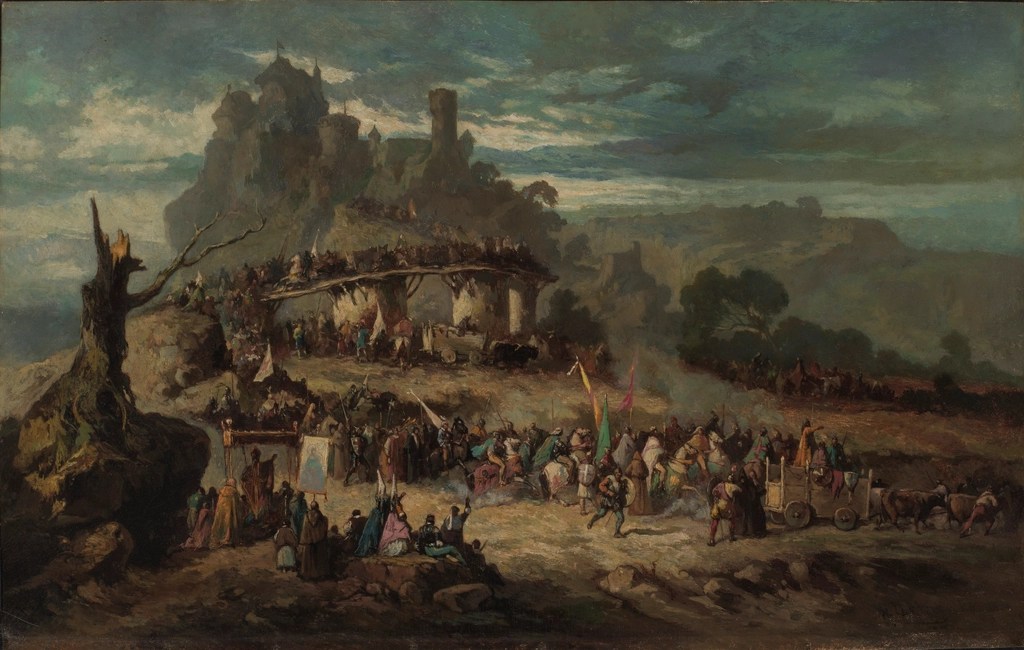
Popular myths about the Crusades
Many popular myths about the Crusades pervade popular books and skeptics websites today even though many of the myths have been debunked. The myths continue to grow and, in popular works, the myths are considered the gospel truth. In this essay, I will first explore some of the popular myths. Then, I will provide a brief response to those myths.
Recent articles on the Crusades claim that the goal of the crusades was a quest for new lands[1] and was the first round of European colonialism[2]. Popular atheists, such as Dawkins and Hitchens, claim the motivation for the crusades was to convert the pagans or to kill them. Hitchens, in his bestselling book God is not Great; How Religion Poisons Everything, claims that religion can’t help itself. “It must seek to interfere with the lives of nonbelievers, or heretics, or adherents of other faiths.”[3] In The God Delusion, author Richard Dawkins makes the outrageous claim, “Christianity, too, was spread by the sword, wielded first by Roman hands after the Emperor Constantine raised it from eccentric cult to official religion, then by the Crusaders, and later by the conquistadores and other European invaders and colonists, with missionary accompaniment.”[4]
Another popular claim is that the crusades were much more barbaric than typical warfare at that time. Hitchens cites one event, “However, this made no difference during the Crusades, when a papal army set out to recapture Bethlehem and Jerusalem from the Muslims, incidentally destroying many Jewish communities and sacking heretical Christian Byzantium along the way, and inflicted a massacre in the narrow streets of Jerusalem, where, according to the hysterical and gleeful chroniclers, the spilled blood reached up to the bridles of the horses.”[5] Atheist blogger Austin Cline claims, “The Crusades were an incredibly violent undertaking, even by medieval standards.”[6]
The crusades are often cited as an example of religion being the cause of violence. Sam Harris claims religion is a well-spring of violence[7] Cline claims the crusades were, “Hardly a noble quest in foreign lands, the Crusades represented the worst in religion generally and in Christianity specifically.”[8] Atheist Massimo Pigliucci blogs that religion is the cause of violence and cites the crusades as an example, “Just look at the history of all three Abrahamic faiths: Jews used to go around pillaging, raping and merrily engaging in (god-sanctioned) genocide; we owe to Christians the invention of the words crusade and inquisition.”[9] Sam Harris goes so far as to claim “There is no telling what our world would now be like had some great kingdom of reason emerged at the time of the Crusades and pacified the credulous multitudes of Europe and the Middle East.”[10]
The crusades are often claimed to be the worst violence ever. Hitchens questions, “When the worst has been said about the…Crusades…is it not true that secular and atheist regimes have committed crimes and massacres that are, in the scale of things, at least as bad if not worse?”[11] The answer he gives to his question is no. Pigliucci, goes further and claims that religions, other than Christianity, Islam and Judaism, are far more peaceful.[12]
These claims about the crusades have led the word ‘crusade’ to become taboo. One helpful atheist advises, “Churches should not use the word Crusade because it turns people off because of it’s negative connotations.”[13] Some Christians have accepted the claims and have tried to distance their friendlier version of Christianity from the, “…intolerant, politicized, ugly, right-wing…”[14] Christianity. Anonymous atheist blogger “vjack” agrees with the negative connotations of the word ‘crusade’ and cautions other atheist not to forget the crusades or stop using the word. His conspiracy laden fear is that if they forget the crusades happened they will happen again because, “The consolidation of political power, military strength, and massive wealth into Christian extremist hands is something that should terrify every atheist.”[15]
Dispelling myths about the Crusades
Words have meaning and some words have emotional baggage that gives them more persuasion power when used. Think about it; when you hear the word ‘crusade’ what images are conjured up in your mind? Do you think of greedy nobles looking to grab lands from the peaceful Muslims and other Christians? Do you think of an unprovoked and extraordinary brutal war? Do you see another episode of Jewish genocide? Do you imagine being given the choice to convert or die? Do you think of the worst episode of violence in human history? Misconceptions about the crusades have given this word the emotional baggage that is often used as a coercive rhetorical device for anti-Christian arguments.
There is a subtle and underlining claim with all of these statements against the Crusades that implies that Christianity is falsified somehow. Christianity obviously can’t be true because of all the violence it causes is the unspoken claim. No rational argument is now needed; one simply needs to remind the Christian of the crusades and that should be the end of the argument. However, a word with emotional baggage and an implied refutation is not rational discourse. It simply is coercive and vacuous rhetoric designed to influence rather than inform.
As with any investigation into history, we run the risk of oversimplifying the issues involved or looking at the events from one side only, either seeing only the good actions or only the bad actions. The crusades are no different. My attempt here is not to dismiss any of the wrongs committed by crusades and only look at what could be called the good. I instead intend to look at both sides equitably.
Now, in order to dispel these myths, we need to start with a good definition of what exactly is a crusade. Jonathan Riley-Smith defines the crusades as, “a…expedition authorized by the pope on Christ’s behalf, the leading participants in which took vows and consequently wore crosses and enjoyed the privileges of protection at home and the indulgence, which, when the campaign was not destined for the East, was equated with that granted to crusaders to the Holy Land.”[16] Knowing what the crusades were does not, necessarily, tell us anything about the motivations. For that we must dig into history and the situations that were prevalent at the time.
It is important to note that, before the rise of Islam, the Christian world covered from Britton to the Middle East, along the North coast of Africa, along the Nile all the way to Axum, areas in the Arabian Peninsula, and from modern day Turkey to Baghdad. In 700 AD Christianity covered more area than the Roman Empire. By 850, over 100 years after the Death of Mohammad, the Muslims had conquered the Middle East from India to Turkey, and across North Africa and into most of Spain. It is no small fact that over half of the Christian world was then under Muslim control. The rapid rise of Islam would not have gone unnoticed and without concern. Thomas Madden makes the point, “It is important to remember that in the Middle Ages the West was not a powerful, dominant culture venturing into a primitive or backward region. It was the Muslim East that was powerful, wealthy and opulent. Europe was the Third World.”[17]
By the time of the first crusade the Seljuk Turks had made their way across Anatolian peninsula and threated Constantinople. With no other alternative, the Byzantine emperor Alexius I Comneus, sent a letter to Pope Urban II requesting help from the Western Empire.[18] Pope Urban II headed the call and preached the first crusade at the Council of Clermont on November 27, 1095.[19] Urban II asked those there to come to the aid of their fellow Christians against the atrocities of the Turks. Concerning the Turks he spoke, “They have occupied more and more of the lands of those Christians, and have overcome them in seven battles. They have killed and captured many, and have destroyed the churches and devastated the empire. If you permit them to continue thus for a while with impurity, the faithful of God will be much more widely attacked by them.”[20] Clearly the concern was that if they did not push back the Turks they would continue on into Europe. The impetus was to prevent further encroachment and to regain lost lands, not for themselves but for the Byzantines. In short, the crusades were provoked.
The charge is often given that the crusades were the first round of European colonialism. Again this charge is meritless. Thomas F. Madden, chair of St. Louis University’s history department, crusade expert and author of “A Concise History of the Crusades,” agrees that the Crusaders were a defensive force that did not intend profit from their ventures by earthly riches or land. Some may suggest that it was the motivation of Bohemond I, Prince of Taranto, during the first crusade when he refused to relinquish Antioch to Byzantine control. Bohemond refused to relinquish Antioch to Alexius and the Byzantines because he felt they had forfeited their rights to Antioch when they turned their back on it and did not assist the crusader army when they needed it most.[21] Of course not all crusaders agreed with Bohemond. Raymond IV of Count of Toulouse, stressed that “no crusader should be allowed to renounce that sacred vow for temporal gain.”[22] In fact, when the crusades were complete most of the crusades went home with very few remaining to govern their newly acquired lands.[23]
James Ludlow relates the required motivation that was adopted by the Council of Clermont, “As already indicated, one very important privilege is to be found in the list of canons adopted by the Council of Clermont, namely, that an indulgence was to be granted to all who should go to liberate Jerusalem, provided they were motivated not by desire for honor or money, but by devotion only.”[24] Simply put, the motivation of a very small minority of crusaders may have been for temporal gain while most of them considered it a duty and devotion.
You might agree about the motivation but still take exception to the brutal means the crusaders used. Often cited is the massacre of Jerusalem in 1099. Unfortunately a chronicler at the time used hyperbole to greatly exaggerate the claims of the bloodshed. Often this account is read as literal gospel truth and not the exaggeration that it clearly is. There wasn’t enough people in the entire Middle East to fill the City with blood up to the horses’ bridal. It is important to remember the use of hyperbole in warfare and the context of warfare in the period. The exaggerated claim of blood up to a horse’s bridal, an obvious reference to Revelation 14:19-20, may have served as fodder for psychological warfare.
Putting fear into the hearts of your enemy is a well-known psychological warfare tactic. Terrorizing and horrifying your enemy as a means of demoralizing them is part and parcel of any tactical warfare. Grandiose claims of Spartan brutality would put such fear into any opposing army that often when the Spartans took the field the opposing forces would flee in fear leaving the Spartans with a victory without the need for further bloodshed. One of the best examples in history was Vlad III Dracula that earned him the title Vlad the Impaler. “According to historical accounts, when the Shah-in Shah’s forces encountered the massive field of impaled soldiers captured from previous encounters with Vlad’s army, he turned back.”[25] This allowed the outnumbered forces of Vlad to withstand the overwhelming Turkish and Ottoman forces. Exaggerated claims have been utilized in warfare as a means to inspire troops to continue on and to put fear into the hearts of the enemy in an attempt to limit further bloodshed.
The rules of war for the time would have seen it a justified if the whole city was put to death for resisting a besieging army. Madden puts it this way,
“The accepted moral standard in all pre-modern European and Asian civilizations was that a city that resisted capture and was taken by force belonged to the victorious forces. That included not just the buildings and goods, but the people as well. That is why every city or fortress had to weigh carefully whether it could hold out against besiegers. If not, it was wise to negotiate terms of surrender. In the case of Jerusalem, the defenders had resisted right up to the end. They calculated that the formidable walls of the city would keep the Crusaders at bay until a relief force from Egypt could arrive. They were wrong. When the city fell, therefore, it was put to the sack. Many were killed, yet many others were ransomed or allowed to go free.”[26]
By today’s standards we may think of this tactic as being unnecessarily brutal. Is it really more brutal than the warfare today? One need not look farther than the justification of dropping the bomb on Hiroshima and Nagasaki. As terrible as those events were, the number of casualties were far less than would have been had the United States had to invade mainland Japan. As terrific as the bombs were the result was a speedy conclusion to the war.
Madden concludes, “It is worth noting that in those Muslim cities that surrendered to the Crusaders the people were left unmolested, retained their property and were allowed to worship freely.”[27] Simply put, incentives for non-resistance were used to lower casualties in ancient times and this practice is still in use today. I t is also worthy to note that often a single atrocious act is often cited as an example of the normal behavior of the crusaders instead of for the abnormal behavior that it is. For example, Atheist Austin Cline says, “When Muslim cities were captured by Christian crusaders, it was standard operating procedure for all inhabitants – no matter what their age – to be summarily killed.” [Emphasis added][28] This was not the standard operating procedure for crusaders and irresponsible to make such an outrageous claim.
These are common warfare tactics, not religious or secular practices. Richard Dawkins rightly notes, “Cruel and evil people can be found in every century and of every persuasion.”[29] If true, he has no legitimate reason to lay the charge of brutality because of religion at the feet of Christianity. It wasn’t religious purposes for any so called brutal tactics, it was simply the accepted art of war. William Cavanaugh has recently made the argument that the religious violence is a myth because it simplifies a complex set of social, economic and political factors that lead to violence. Indeed it seems bias for an Atheist to claim all violence is caused by religion as if institutionalized atheism is innocent. Cavanaugh theorizes that this is an attempt to perpetuate the myth that religion creates violence while making the atheists out to be the rational and peaceful people. Cavanaugh states, “The myth of religious violence helps to construct and marginalize a religious Other, prone to fanaticism, to contrast with the rational, peace-making, secular subject.”[30] Further he states, “These arguments are part of a broader Enlightenment narrative that has invented a dichotomy between the religious and the secular and constructed the former as an irrational and dangerous impulse that must give way in public to rational, secular forms of power.”[31]
It is also important to note that nowhere did Jesus Christ condone such actions. If Christians did involve themselves in the practices of warfare that we think are not very Christian, like maybe it is precisely because they are not acting like Christians and not that secularism is more enlightened. Cavanaugh makes the point that, “it may be the case that the Crusader has misappropriated the true message of Christ, but one cannot therefore excuse Christianity of all responsibility.”[32] It is one of the doctrines of Christianity that all people sin, even Christians. Although Christians sinning is consistent with Christian doctrine it does not excuse or condone such behavior.
It is also important to note that the Crusader army was not made up of all Christians. The reformer Martin Luther raises this objection in his work Vom Kriege wider die Türken (On War Against the Turk). Luther claims, “It is against [Christ’s] name, because in such an army there are scarcely five Christians, and perhaps worse people in the eyes of God than are the Turks; and yet they would all bear the name of Christ.”[33] In a way Luther is objecting to the religious labeling for this war. The crusades being a defensive war need not drag Christ’s name into it in order to justify the call to war.
What about Christians who sought to eliminate the enemy at home like Count Emicho Leiningen in the first crusade or Radulf during the second crusade? Dan Cohn-Shebok author of The Crucified Jew, wrote, “The Crusades and their aftermath thus brought into focus Christian contempt for the Jews who stubbornly clung to their ancestral Faith.”[34] The crusades are often viewed as part of an ongoing genocide of Jews by Christians.
First it is important to note that the crusade was never called against the Jew. Jonathan Riley Smith notes, “No crusade was actually proclaimed against the Jews, although crusade preaching unleashed feelings that the Church could not control.”[35] Second they attempted to stop rogue crusaders from harming the Jews. During the second crusade Bernard of Clairvaux set off to stop Radulf’s attacks against the Jews. “Repeatedly, Barnard stressed that the Jews were not to be persecuted.”[36] In short, the church never called for a crusade against the Jew and they sought to stop those who did.
Conclusion
In this essay I have examined some of the more popular myths about the crusades and have attempted to shed new light on the truth about the subject. I think Stark sums up my conclusions best when he writes, “The Crusades were not unprovoked. They were not the first round of European colonialism. They were not conducted for land, loot, or converts. The crusaders were not barbarians who victimized the cultivated Muslims. They sincerely believed that they served in God’s battalions.”[37] I would add to his conclusion that the crusades were never called against the Jew.
As for Christian morality, Christians sometimes sin, and this in no way excuses any sinful actions. And if a Christian does not follow the teachings of Christ then he/she may be a hypocrite but that does not mean Christianity causes violence or somehow falsify the Christian worldview. If I were a smoker who smoked 5 packs of cigarettes a day and I told you that smoking was harmful to your health it would make me a pretty big hypocrite. My hypocrisy would in no way falsify my claim that smoking is harmful to your health.
It is my hope that I have shed some light on the issue of the crusades and some of the popular claims and implications that are taken for granted in our popular culture today. With that I also hope people will evaluate explore those claims as they carefully consider and weigh multiple sides of this issue.
Works Cited
Alvarez, Malo. Scare Tactics and the Art of War. 13 Aug 2007. 8 Dec 2012. <http://ezinearticles.com/?Scare-Tactics-and-the-Art-of-War&id=687005>.
Cavanaugh, William T. The Myth of Religious Violence: Secular Ideology and the Roots of Modern Conflict (Kindle Edition). Oxford: Oxford University Press, 2009.
Cline, Austin. “Causes, History, and Violence of the Crusades.” n.d. About.com. 29 November 2012. <http://atheism.about.com/od/crusades/a/crusades_4.htm>.
Cohn-Sherbok, Dan. The Crucified Jew: Twenty Centuries of Christian Anti-Semitism. London: HarperCollons Publishers, 1992.
Dawkins, Richard. The God Delusion (Kindle Edition). Houghton Mifflin Harcourt, 2008.
Dennett, Daniel C. Breaking the Spell : Religion as a Natural Phenomenon. New York: Viking Penguin, 2006.
Guisepi, Robert A. “The Crusades.” n.d. International World History Project. 5 December 2012. <http://history-world.org/crusades.htm>.
Harris, Sam. The End of Faith: Religion, Terror, and the Future of Reason (Kindle Edition). Norton, 2005.
Hitchens, Christopher. God Is Not Great: How Religion Poisons Everything (Kindle Edition). Twelve Books, 2007.
Ludlow, James. The Crusades (Kindle Edition). Amazon Digital Services, 2011.
Luther, Martin. Vom Kriege wider die Türken (On War Against the Turk). 1528. 5 Dec 2012. <http://www.lutherdansk.dk/On%20war%20against%20Islamic%20reign%20of%20terror/On%20war%20against%20Islamic%20reign%20of%20terror1.htm>.
Madden, Thomas F. The New Concise History of the Crusades (Critical Issues in World and International History). Rowman & Littlefield Publishers, 2005.
Madden, Thomas. “What the Crusades Were Really Like.” 10 Oct 2004. Cephas Library. 5 December 2012. <http://www.cephas-library.com/catholic/catholic_what_crusaders_were_really_like.html>.
Mehta, Hemant. “You’re Holding a What? You’re Holding it When?!” 2 September 2011. The Friendly Atheist. 2012 November 2012. <http://www.patheos.com/blogs/friendlyatheist/2011/09/02/youre-holding-a-what-youre-holding-it-when/>.
Pigliucci, Massimo. “My Society Is Better Than Yours.” 1 October 2012. Rationally Speaking. 29 November 2012. <http://rationallyspeaking.blogspot.com/2012/10/my-society-is-better-than-yours.html>.
Riley-Smith, Jonathan. Rethinking the Crusades. March 2000. 5 Decvember 2012. <http://catholiceducation.org/articles/history/world/wh0042.html>.
—. What Were the Crusades? 4th Ed. Ignatius Press, 2009.
Schaeffer, Frank. “The “New Atheist” Crusade and Me .” 1 July 2009. Huffington Post. 29 November 2012. <http://www.huffingtonpost.com/frank-schaeffer/the-new-atheist-crusade-a_b_222864.html>.
Stark, Rodney. God’s Battalions (Kindle Edition). HarperCollins Publishers, 2009.
Urban II. Medieval Sourcebook. 1997. 8 December 2012. <http://www.fordham.edu/halsall/source/urban2-5vers.html>.
vjack. “Why Atheists Can’t Let Go of the Crusades.” 24 September 2009. Atheist Revolution. 29 November 2012. <http://www.atheistrev.com/2009/09/why-atheists-cant-let-go-of-crusades.html>.
Footnotes
[1] Cline, Austin. “Causes, History, and Violence of the Crusades.” n.d. About.com. 29 November 2012. <http://atheism.about.com/od/crusades/a/crusades_4.htm>.
[2] Guisepi, Robert A. “The Crusades.” n.d. International World History Project. 5 December 2012. <http://history-world.org/crusades.htm>.
[3] Hitchens, Christopher. God Is Not Great: How Religion Poisons Everything (Kindle Edition). Twelve Books, 2007. (338-339)
[4] Dawkins, Richard. The God Delusion (Kindle Edition). Houghton Mifflin Harcourt, 2008. Locations 660-662
[5] Hitchens, Christopher. God Is Not Great: How Religion Poisons Everything (Kindle Edition). Twelve Books, 2007. Locations 444-447
[6] Cline, Austin. “Causes, History, and Violence of the Crusades.” n.d. About.com. 29 November 2012. <http://atheism.about.com/od/crusades/a/crusades_4.htm>.
[7] Harris, Sam. The End of Faith: Religion, Terror, and the Future of Reason (Kindle Edition). Norton, 2005. Location 304
[8] Cline, Austin. “Causes, History, and Violence of the Crusades.” n.d. About.com. 29 November 2012. <http://atheism.about.com/od/crusades/a/crusades_4.htm>.
[9] Pigliucci, Massimo. “My Society Is Better Than Yours.” 1 October 2012. Rationally Speaking. 29 November 2012. <http://rationallyspeaking.blogspot.com/2012/10/my-society-is-better-than-yours.html>.
[10] Harris, Sam. The End of Faith: Religion, Terror, and the Future of Reason (Kindle Edition). Norton, 2005. (1632-1634)
[11] Hitchens, Christopher. God Is Not Great: How Religion Poisons Everything (Kindle Edition). Twelve Books, 2007. Locations 3624-3626
[12] Pigliucci, Massimo. “My Society Is Better Than Yours.” 1 October 2012. Rationally Speaking. 29 November 2012. <http://rationallyspeaking.blogspot.com/2012/10/my-society-is-better-than-yours.html>.
[13] Mehta, Hemant. “You’re Holding a What? You’re Holding it When?!” 2 September 2011. The Friendly Atheist. 2012 November 2012. <http://www.patheos.com/blogs/friendlyatheist/2011/09/02/youre-holding-a-what-youre-holding-it-when/>.
[14] Schaeffer, Frank. “The “New Atheist” Crusade and Me.” 1 July 2009. Huffington Post. 29 November 2012. <http://www.huffingtonpost.com/frank-schaeffer/the-new-atheist-crusade-a_b_222864.html>.
[15] vjack. “Why Atheists Can’t Let Go of the Crusades.” 24 September 2009. Atheist Revolution. 29 November 2012. <http://www.atheistrev.com/2009/09/why-atheists-cant-let-go-of-crusades.html>.
[16] Riley-Smith, Jonathan. What Were the Crusades? 4th Ed. Ignatius Press, 2009. p 5
[17] Madden, Thomas. “What the Crusades Were Really Like.” 10 Oct 2004. Cephas Library. 5 December 2012. <http://www.cephas-library.com/catholic/catholic_what_crusaders_were_really_like.html>
[18] Stark, Rodney. God’s Battalions (Kindle Edition). HarperCollins Publishers, 2009. (Location 53)
[19] Madden, Thomas F. The New Concise History of the Crusades (Critical Issues in World and International History). Rowman & Littlefield Publishers, 2005. p 7
[20] Urban II. Medieval Sourcebook. 1997. 8 December 2012. <http://www.fordham.edu/halsall/source/urban2-5vers.html>.
[21] Madden, Thomas F. The New Concise History of the Crusades (Critical Issues in World and International History). Rowman & Littlefield Publishers, 2005. p 30
[22] Madden, Thomas F. The New Concise History of the Crusades (Critical Issues in World and International History). Rowman & Littlefield Publishers, 2005. p 30
[23] Madden, Thomas. “What the Crusades Were Really Like.” 10 Oct 2004. Cephas Library. 5 December 2012. <http://www.cephas-library.com/catholic/catholic_what_crusaders_were_really_like.html>
[24] Ludlow, James. The Crusades (Kindle Edition). Amazon Digital Services, 2011. Locations 4551-4553
[25] Alvarez, Malo. Scare Tactics and the Art of War. 13 Aug 2007. 8 Dec 2012. <http://ezinearticles.com/?Scare-Tactics-and-the-Art-of-War&id=687005>.
[26] Madden, Thomas. “What the Crusades Were Really Like.” 10 Oct 2004. Cephas Library. 5 December 2012. <http://www.cephas-library.com/catholic/catholic_what_crusaders_were_really_like.html>
[27] Madden, Thomas. “What the Crusades Were Really Like.” 10 Oct 2004. Cephas Library. 5 December 2012. <http://www.cephas-library.com/catholic/catholic_what_crusaders_were_really_like.html>
[28] Cline, Austin. “Causes, History, and Violence of the Crusades.” n.d. About.com. 29 November 2012. <http://atheism.about.com/od/crusades/a/crusades_4.htm>.
[29] Dawkins, Richard. The God Delusion (Kindle Edition). Houghton Mifflin Harcourt, 2008. Locations 4761-4762
[30] Cavanaugh, William T. The Myth of Religious Violence: Secular Ideology and the Roots of Modern Conflict (Kindle Edition). Oxford: Oxford University Press, 2009. Locations 63-64
[31] Cavanaugh, William T. The Myth of Religious Violence: Secular Ideology and the Roots of Modern Conflict (Kindle Edition). Oxford: Oxford University Press, 2009. Locations 78-80
[32] Cavanaugh, William T. The Myth of Religious Violence: Secular Ideology and the Roots of Modern Conflict (Kindle Edition). Oxford: Oxford University Press, 2009. Locations 99-100
[33] Luther, Martin. Vom Kriege wider die Türken (On War Against the Turk). 1528. 5 Dec 2012. <http://www.lutherdansk.dk/On%20war%20against%20Islamic%20reign%20of%20terror/On%20war%20against%20Islamic%20reign%20of%20terror1.htm>
[34] Cohn-Sherbok, Dan. The Crucified Jew: Twenty Centuries of Christian Anti-Semitism. London: HarperCollons Publishers, 1992. p 43
[35] Riley-Smith, Jonathan. Rethinking the Crusades. March 2000. 5 December 2012. <http://catholiceducation.org/articles/history/world/wh0042.html>.
[36] Madden, Thomas F. The New Concise History of the Crusades (Critical Issues in World and International History). Rowman & Littlefield Publishers, 2005. p 54
[37] Stark, Rodney. God’s Battalions (Kindle Edition). HarperCollins Publishers, 2009. locations 3371-3373

 Treasures of the Elysian Fields
Leave a comment